
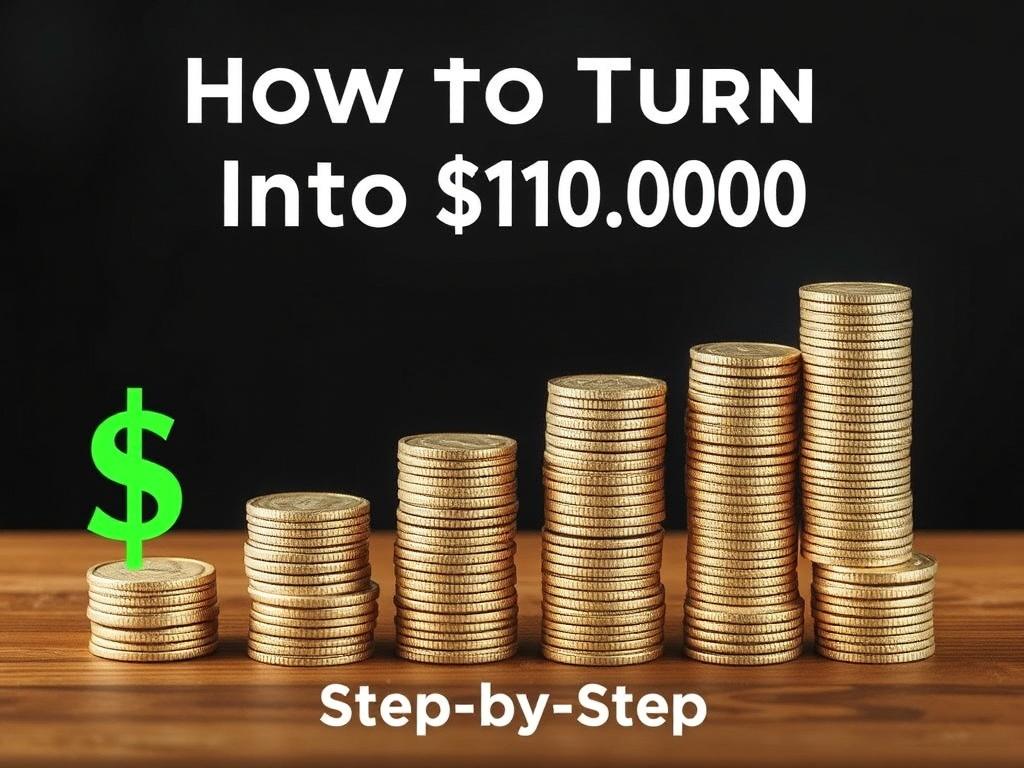
Asking how to turn $1,000 into $10,000 (Step-by-Step) is not a fantasy—it’s a project with choices, trade-offs, and measurable actions. You can compound returns through investing, create value with a side hustle, or flip goods and services; each path demands different time, risk tolerance, and skills. This article lays out clear steps you can follow, with examples and a simple decision framework so you can pick a route that fits your life. Read on to choose a realistic path and start moving capital instead of watching it sit.
Step 1: set a target and timeline
Begin by translating $10,000 into a timeline and a required return. If you want tenfold growth in a year you need extraordinarily high monthly returns, which means higher risk; stretching the horizon to 3–5 years allows for steadier strategies like investing and reinvesting earnings. Write a specific target date and the minimum monthly or quarterly gains you need—this turns an abstract goal into an operational plan.
Having a clear deadline also informs the tactics you’ll accept. Short timelines push you toward active trades, flipping, or launching fast-turnaround services; longer timelines favor compounding investments and small business growth. Decide which trade-offs you can live with, then commit to tracking progress weekly or monthly so you can pivot if results lag.
Step 2: protect capital and allocate smartly
Before taking risks, set aside a small buffer so one setback doesn’t wipe you out. Keep $100–$300 as an emergency buffer and use the remaining amount as working capital; for example, start with $800 to deploy and $200 reserved to cover unexpected fees or returns. This preserves your ability to keep trading or scaling if a single venture falters.
Divide your working capital across experiments rather than betting everything on one idea. A simple split might be 40% on a primary strategy, 30% on a secondary test, and 30% held to double down on winners. That approach limits downside while giving you the flexibility to identify what actually produces returns.
Step 3: choose a strategy that matches your skills
Investing: individual stocks, ETFs, and dividend plays
If you enjoy reading financial reports and tracking companies, investing could be the most passive route after initial setup. With $1,000 you can buy a mix of low-cost ETFs and a couple of well-researched individual stocks, reinvesting dividends and adding any extra cash from side income. Expect steadier but slower progress unless you accept higher short-term risk through concentrated positions or options trading.
Options or margin can accelerate returns but magnify losses—treat them as advanced tools only after you’ve practiced with paper trading or small sizes. Over a 3–5 year horizon, consistent monthly additions and dividend reinvestment can turn modest capital into much larger sums thanks to compound growth.
Flipping and reselling: buy low, sell higher
Buying undervalued items locally or online and reselling them has one of the fastest feedback loops. I started with small electronics and furniture, using $600 to source goods and $400 as reserve, and scaled by reinvesting every profit; within a year the monthly turnover and margins built momentum. The skill set here is sourcing, basic repair, good photography, and knowing marketplaces where buyers pay more.
Margins vary by item: small electronics might return 20–100% per flip, while furniture can yield larger absolute profits but slower turnover. Keep records of costs, shipping, and fees so you know true profitability, and focus on niches where you develop an edge—value increases with knowledge.
Service-based microbusiness: skills turned into cash
Use what you know to sell a service—graphic design, freelance writing, tutoring, or local handyman work. Services scale by raising rates, improving efficiency, or hiring subcontractors; an initial $1,000 buys advertising, tools, or training to jumpstart sales. This path often gives the most controllable path from $1,000 to $10,000 because you exchange time and expertise for predictable income.
Start with small gigs, ask for referrals, and reinvest profits into marketing and basic automation like invoicing or scheduling tools. As revenue grows, document repeatable processes so work becomes delegable and your business compounds beyond what you alone can do each week.
Step 4: test fast, scale the winners
Run multiple small experiments and double down on the one that produces the best return-on-time and capital. Track metrics—gross margin, time per sale, customer acquisition cost—and set thresholds for scaling, such as reinvesting 70% of profits into the winning channel until you reach a new benchmark. This disciplined approach turns random luck into repeatable progress.
Here’s a simple decision checklist to scale: (1) Does this strategy earn consistent net profit? (2) Is the work repeatable and scalable? (3) Can you automate or outsource parts of it? If the answer is yes to all three, allocate more capital and formally document processes to maintain quality while growing.
Step 5: manage risk, tax, and exit strategies
Know how taxes and fees affect net returns—sales platforms, payment processors, and capital gains all reduce your profit if unaccounted for. Keep clean records and set aside a realistic percentage for taxes from the start to avoid surprises at filing time. Regularly evaluate whether to take profits, reinvest, or diversify into safer assets as your capital grows.
Decide in advance when you’ll harvest gains: after a percentage increase, after a time period, or once you hit a financial milestone. Having exit rules prevents emotional decisions and locks in progress toward the tenfold goal while preserving the ability to pivot if markets or demand change.
A simple comparison table
| Strategy | Estimated time | Risk | Effort |
|---|---|---|---|
| Index/ETF investing | 3–5 years | Low–Medium | Low |
| Flipping/reselling | 6–18 months | Medium | High |
| Service microbusiness | 3–12 months | Medium | High |
Turning $1,000 into $10,000 is about picking an approach that fits your tolerance and then executing with discipline. Start small, measure everything, and reinvest intelligently while protecting a safety cushion. With consistent effort, realistic expectations, and careful risk management, that tenfold goal moves from a headline into an achievable plan you can act on today.
